What we do

Advancing a regenerative approach to discogenic chronic low back pain

Cartago Biotech is developing CBT005, a recombinant protein designed to address degeneration of the lumbar intervertebral disc — the underlying cause of pain for many people with chronic low back pain.

Our goal is to move beyond managing symptoms alone and toward a regenerative approach that may help address the damaged disc itself.

Healthy disc

01

The disc

Intervertebral discs absorb load and allow the spine to move.

When a disc degenerates, it can lose its normal structure and shock-absorbing function. Because the disc has no direct blood supply, healing after injury is a challenge.
Unhealthy disc

02

Degeneration

This process can contribute to persistent pain, reduced mobility, and disability.

90%
of people over 50 show signs of wear and tear in the spinal discs.
#1
cause of Years Lived with Disability globally Low back pain leads every other condition, ahead of depression and headaches.
149M
workdays lost annually to low back pain in the United States.
Medication Therapy Injections Surgery nothing here symptom control irreversible

None of it repairs the disc

03

Current treatments

Today, people with discogenic chronic low back pain are often treated with medication, physical therapy, injections, or, in more advanced cases, surgery. Surgical options are expensive, irreversible, and carry significant risk.

Importantly, none of these treatments address the underlying wear and tear of the spinal disc, as they do not restore or repair the disc itself.

ADJACENT BONE NUCLEUS PULPOSUS Stem cells recruited Chondrocyte progenitors New matrix

CBT005 — a single injection

04

Our approach

CBT005 is a recombinant form of growth differentiation factor 6, or GDF6 — a protein with an important role in disc biology.

It is designed to be delivered as a single injection into the affected lumbar disc. There, it is intended to activate the body's own repair response and support regeneration of damaged disc tissue.

CBT005 is being developed as a potential new option for people with discogenic chronic low back pain who have limited treatment choices between ongoing symptom management and irreversible surgery.

CBT005 at a glance

  1. 01

    Single intradiscal injection

    CBT005 is delivered directly into the affected disc.

  2. 02

    Regenerative biological approach

    CBT005 is designed to engage the biology of disc repair.

  3. 03

    Clinical development

    Its safety and potential benefit are being evaluated in a Phase 1/2 clinical study.

Preclinical evidence

GDF-6 protected discs from degenerating

In a sheep model of disc injury, discs treated with GDF-6 held more of their height than injured discs left untreated, kept their water content, and rebuilt matrix they had lost.

For each sheep, four lumbar discs received either: annular puncture, annular puncture plus GDF-6 injection; surgical exposure only (exposed control), or no surgical exposure (non-visualized control).

Animals
7 male merino wethers, aged 2–4 years
Discs per animal
4 lumbar discs
Follow-up
Assessed at 4, 8 and 12 months

Disc height retained after injury

Disc Height Index, as a ratio of post- to pre-injection height

0.0 0.2 0.4 0.6 0.8 1.0 1.2 pre-injury height GDF-6, 4 months: 1.10 1.10 Control, 4 months: 1.14 1.14 Exposed, 4 months: 0.82 0.82 Stabbed, 4 months: 0.79 0.79 4 months GDF-6, 8 months: 0.79 0.79 Control, 8 months: 0.85 0.85 Exposed, 8 months: 0.79 0.79 Stabbed, 8 months: 0.60 0.60 8 months GDF-6, 12 months: 0.79 0.79 Control, 12 months: 0.82 0.82 Exposed, 12 months: 0.79 0.79 Stabbed, 12 months: 0.60 0.60 12 months
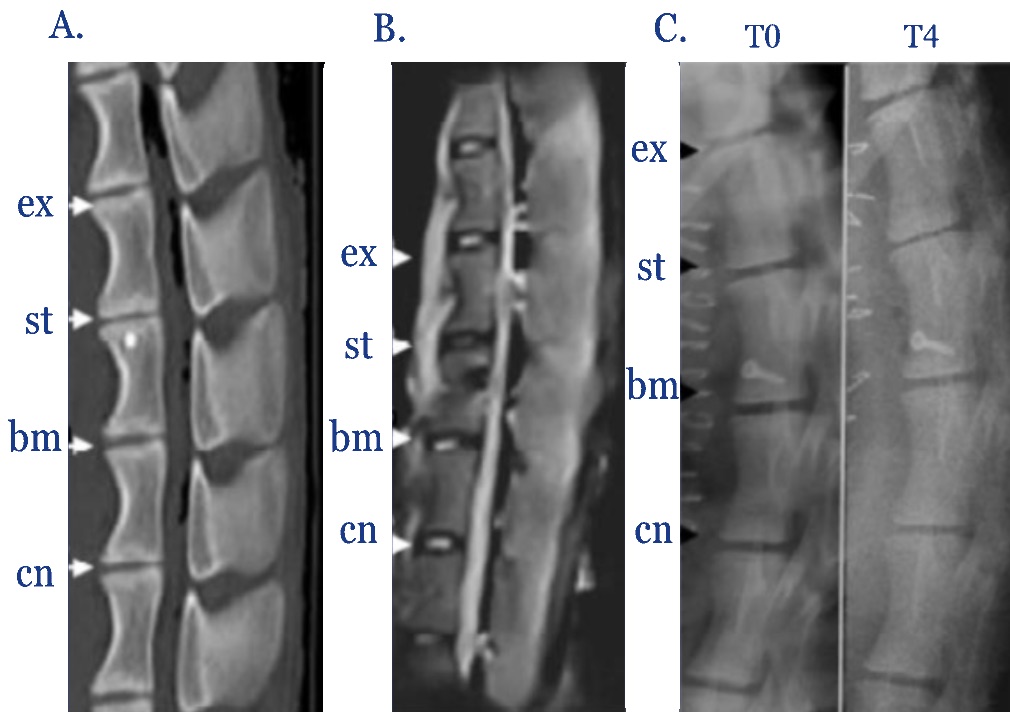
GDF-6 bm
Annular puncture plus GDF-6 injection. The treatment arm. Marked “bm” in the figures, for BMP — the older name for GDF-6.
Control cn
No surgical exposure at all. A healthy, untouched disc.
Exposed ex
Surgical exposure only, no puncture. Separates the effect of the surgery from the effect of the injury.
Stabbed st
Annular puncture, left untreated. The injury model.
MRI and X-ray of sheep lumbar spines showing exposed, stabbed, BMP-13 treated and control discs at T0 and four months.
Scanned sheep spines four months after annular injury, and X-rays taken immediately after surgery (T0) and post mortem at four months (T4).

Water content preserved

  • On MRI, injured untreated discs darkened — the signature of a disc losing its water.
  • Treated discs kept the lighter nucleus of a healthy disc.
  • The loss of hydration was confirmed biochemically over the same period.
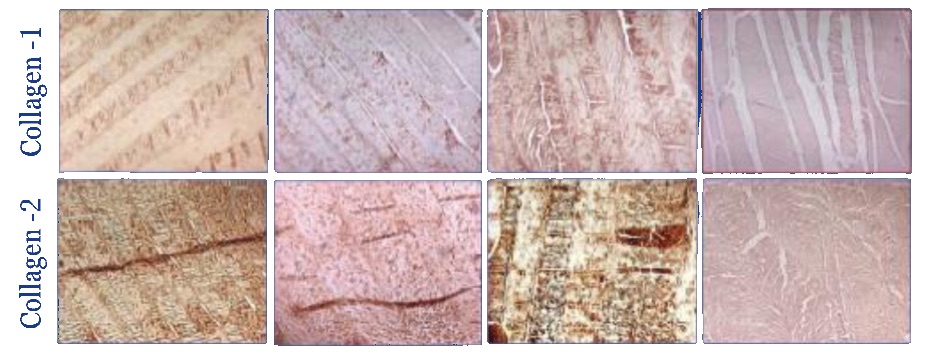
Immunohistochemical staining for collagen I and collagen II across four disc conditions.
GDF-6 injection stimulates collagen synthesis in the annulus fibrosus.

The right collagen rebuilt

  • Newly deposited collagen was predominantly collagen II, the type found in healthy disc.
  • Staining for collagen I — the weaker, scar-type fibre — was minimal.
  • Collagen II expression rose in the inner annulus of treated discs.
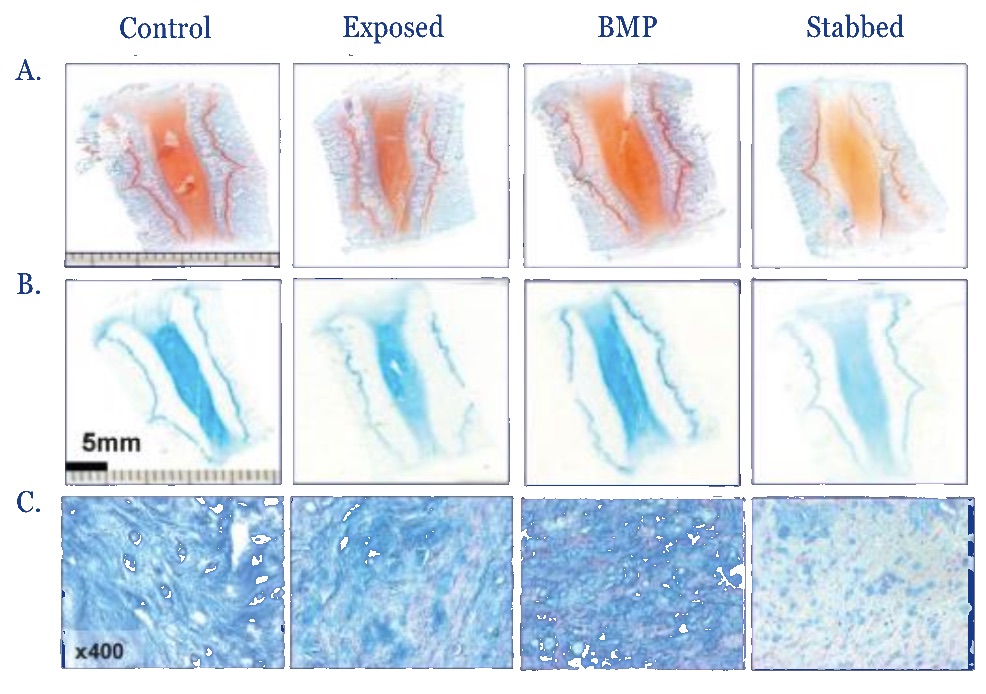
Histological staining of disc tissue across control, exposed, BMP-13 and stabbed conditions at two magnifications.
Histological staining showed GDF-6 affected not only cell numbers but the extracellular matrix those cells produced.

Matrix restored, cells retained

  • GDF-6 reversed or arrested the loss of extracellular matrix seen in control discs.
  • Treated discs held more water at four months and contained more cells in the nucleus.
  • The effect was on matrix production, not cell count alone.

Source: “BMP13 Prevents the Effects of Annular Injury in an Ovine Model.” BMP-13 and GDF-6 are the same protein — the published work uses the older name.

CBT005 is heading into its
first in-human trials.

We are looking for partners to help take it the rest of the way.

CBT005 is still being tested. It has not been approved for use in patients in any country.